Missing a few teeth: partial denture, bridge or implant?
When you still have most of your own teeth, there are three main ways to fill the gaps. Each has a different effect on the teeth you still have.
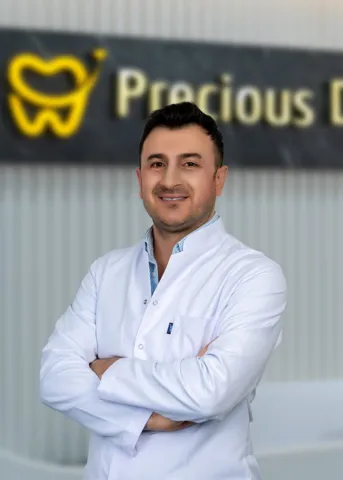 Medically reviewed by Dt. Hüseyin Yavuz Özbek, implant surgeon · Updated October 2026
A partial denture is a removable plate that fills gaps; it's the cheapest option and available on the NHS. A bridge is fixed to the teeth either side of the gap, which usually means reshaping them. An implant replaces the missing root on its own, without touching neighbouring teeth, but needs surgery and is usually private.
The three options
| Partial denture | Bridge | Implant | |
|---|---|---|---|
| How it stays in | Clasps or flexes around your teeth | Cemented to the teeth either side | Fixed into the jawbone |
| Removable? | Yes | No | No |
| Effect on other teeth | Clasps rest on them | Neighbouring teeth are usually reshaped | None |
| Surgery? | No | No | Yes, minor |
| On the NHS? | Yes (Band 3) | Yes (Band 3) | Rarely |
| Cost | Lowest | Middle | Usually highest |
Partial dentures
A partial denture fills the gaps between your own teeth. The Oral Health Foundation describes acrylic partials held by small metal clasps, lighter metal (chrome cobalt) partials for people with strong natural teeth, and flexible partials that grip the teeth without metal clasps.
- lowest cost and no surgery
- can replace several gaps at once
- easy to add a tooth later if needed
- comes out to clean and at night
- clasps can put some pressure on the teeth they hold
Bridges
The NHS describes a bridge as a fixed replacement for a missing tooth or teeth, made from impressions of the surrounding teeth, which support it. It's usually made from metal and porcelain and, unlike a denture, stays in.
- fixed, feels natural
- no surgery
- available on the NHS
- the teeth either side usually have to be reshaped to carry the bridge
- cleaning under it needs special floss or brushes
Implants
An implant replaces the root of the missing tooth and carries a crown on top. The Oral Health Foundation explains that implants can replace one tooth, several teeth or a full set.
- doesn't involve cutting down neighbouring teeth
- fixed and feels natural
- cleaned like your own teeth
- needs minor surgery and around four months' healing
- usually only available privately
- needs enough bone, sometimes a graft
How to choose
- Are the teeth either side healthy? If they're already heavily filled or crowned, a bridge may make more sense. If they're healthy, an implant avoids touching them.
- How many gaps, and where? Several gaps around the mouth often suit a partial denture.
- Fixed or removable? Do you mind taking teeth out to clean?
- Budget and health. Can you have minor surgery, and does the cost fit?
Still not sure? The 2-minute quiz will point you to the options worth discussing.
Our view as a clinic: we'd rather keep a healthy tooth than cut it down for a bridge, which is why we often suggest an implant for a single gap between healthy teeth. But a partial denture is a perfectly good choice for many people. Ask us about your gaps →
Common questions
Is a bridge available on the NHS?
Yes. The NHS lists a bridge as a Band 3 treatment. Your dentist will decide whether it's clinically suitable.
Does it matter if I leave a gap?
It can. The Oral Health Foundation notes that dentures help prevent remaining teeth tipping or drifting into gaps. Ask your dentist whether a gap in your mouth needs filling.
Can one implant replace two teeth?
Sometimes two implants can support a bridge of three or more teeth, so you don't always need one implant per tooth. Your dentist will advise based on your bone and bite.
Sources
- NHS — Dental treatments (bridges, implants, dentures)
- NHS — How much NHS dental treatment costs (Band 3)
- Oral Health Foundation — Dentures (partial dentures, materials)
- Oral Health Foundation — Understanding dental implants
Checked October 2026. Where we give our own view as a clinic, we say so.
Not sure which is right for you?
Tell us what's bothering you about your teeth or denture. A real person replies, in plain English. Free, and no obligation.